I’ve Been an Electrician for 23 Years. Last Spring, My Hand Finally Gave Out Mid-Job — Until I Found This.

Waking up used to be simple.
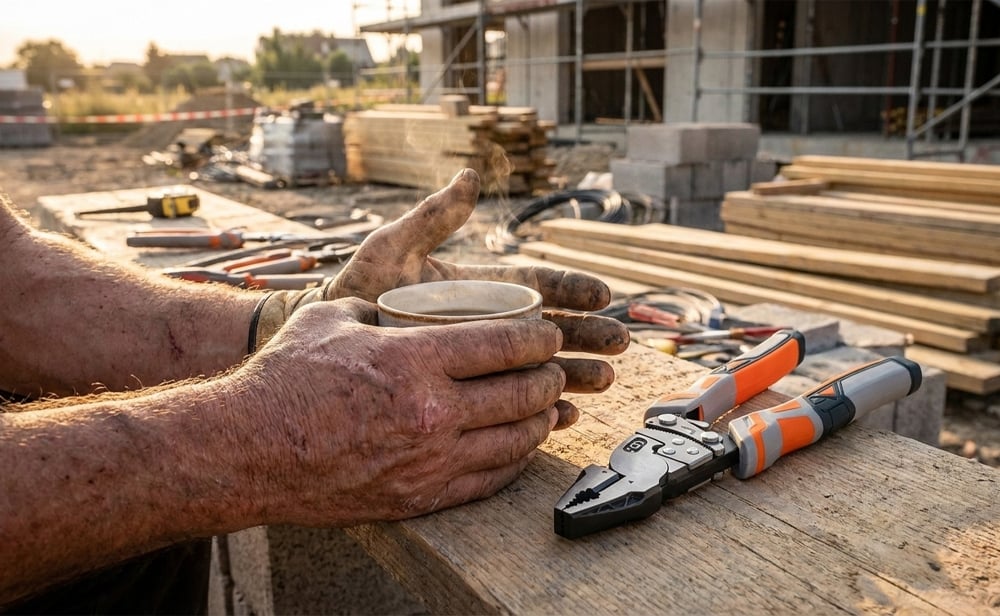
Roll out of bed, grab my coffee, throw my belt on, and go.
But for the past two years, mornings have started with a different routine.
Flex my right hand. Wince. Flex again. Wince again.
The deep, grinding ache in my knuckles is the first thing that greets me every single day — before the coffee even brews.
My wife noticed before I did.
“You’re shaking your hand again,” she’d say over breakfast. I didn’t even realize I was doing it.
I’ve Cut a Million Wires in 23 Years. But Last Spring, the Job Almost Cut Me.
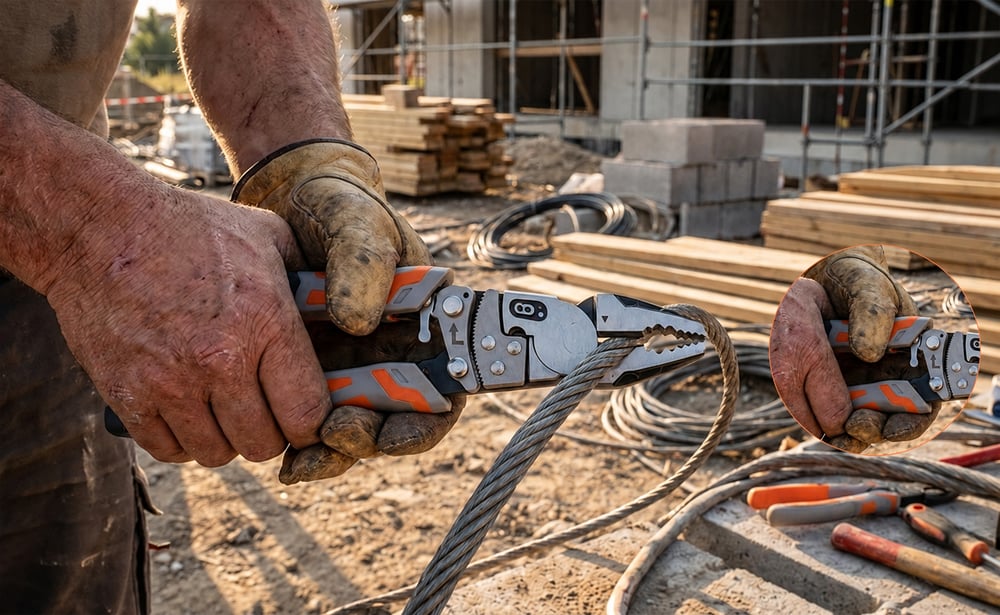
I was up on a ladder in a commercial building, rewiring a panel. Thick steel cable. Third floor. No room to use two hands.
I squeezed my standard pliers with everything I had.
The jaws caught the wire.
I squeezed harder. Veins popping. Forearm burning.
Then — SNAP.
The wire cut. The jaws flew off the cable. My hand rocketed knuckle-first into a steel junction box.
I sat on that ladder for two full minutes, teeth clenched, waiting for the pain to pass.
That was the moment I knew I couldn’t keep doing this the same way.
I Tried Everything to Keep Working Without the Pain
I bought “sharper” pliers. Three different brands.
I switched to lighter linesman pliers thinking less weight meant less strain.
I tried compression gloves. I tried ibuprofen before long jobs. I even spent two months going to a physical therapist who told me, with a straight face, that my best option was “reduce repetitive gripping.”
I’m an electrician. “Reduce gripping” is the job.
I tried wrapping my handle with foam tape to cushion the rebound shock. Still felt every brutal snap.
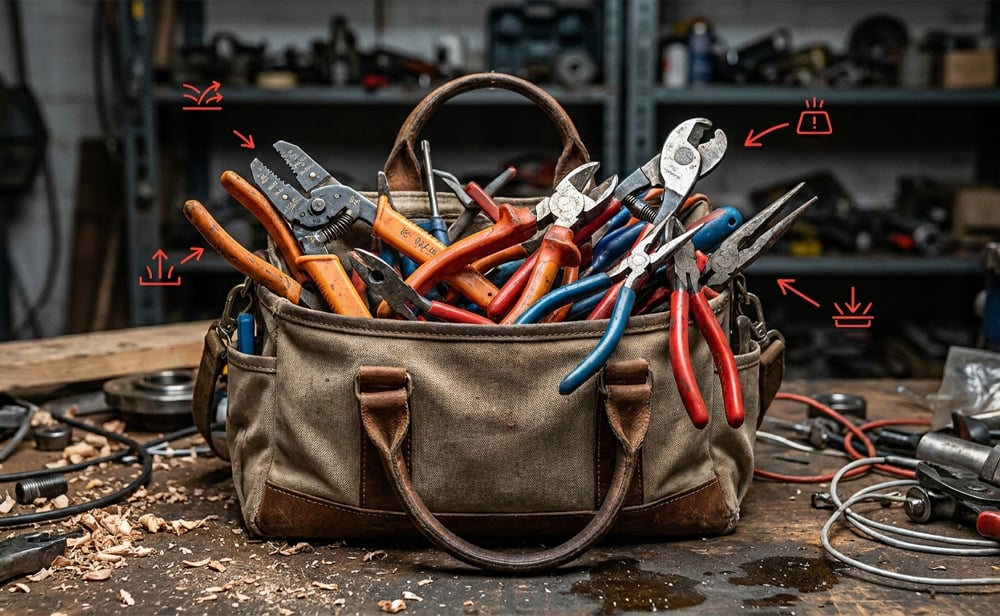
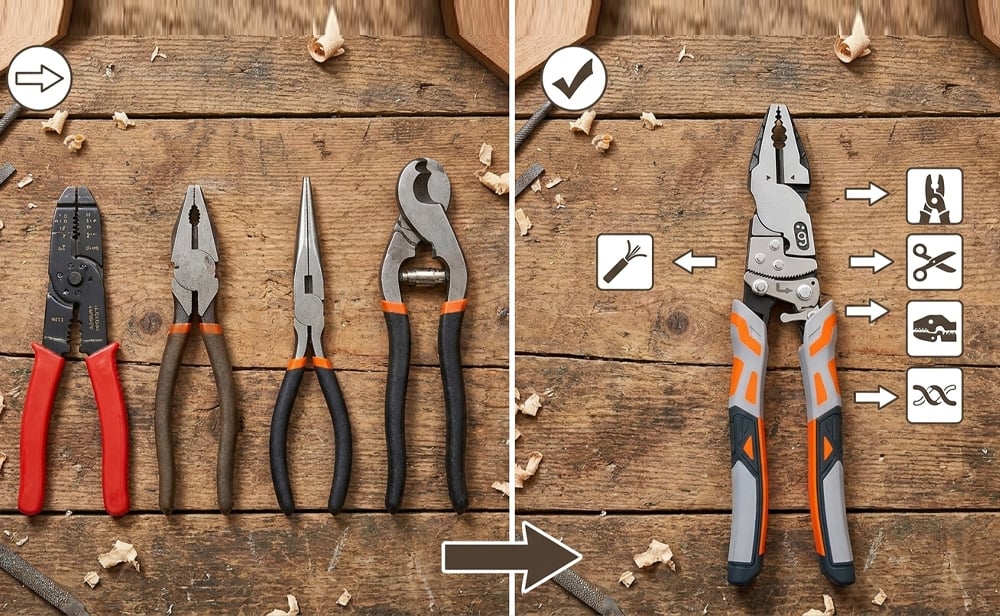
And through all of it — I still had to carry a wire stripper, a linesman, a cutter, and a bender. Four tools. All doing the same basic job. All fighting for space on a belt that was already too heavy.
Nothing worked. And slowly, quietly, I started wondering if my body was just running out of time.
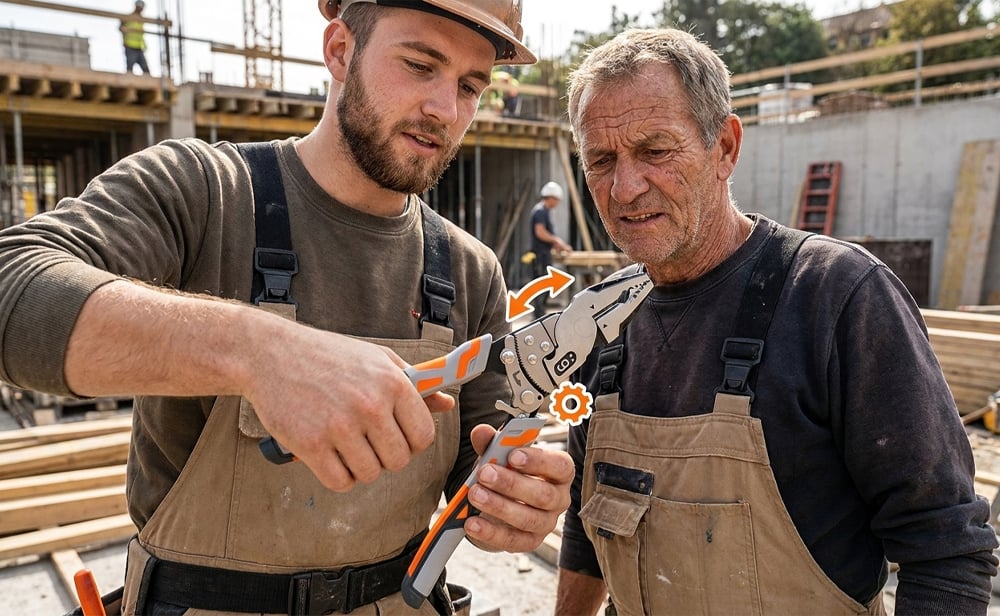
That’s When a Younger Guy on My Crew Showed Me Something I’d Never Seen Before
His name’s Marcus. He’s 31, sharp as a tack, and he’s the kind of guy who researches everything before he buys it.
He was working beside me on a panel job, cutting the same gauge steel cable I was — but without any of the grunting, wincing, or white-knuckling I was doing.
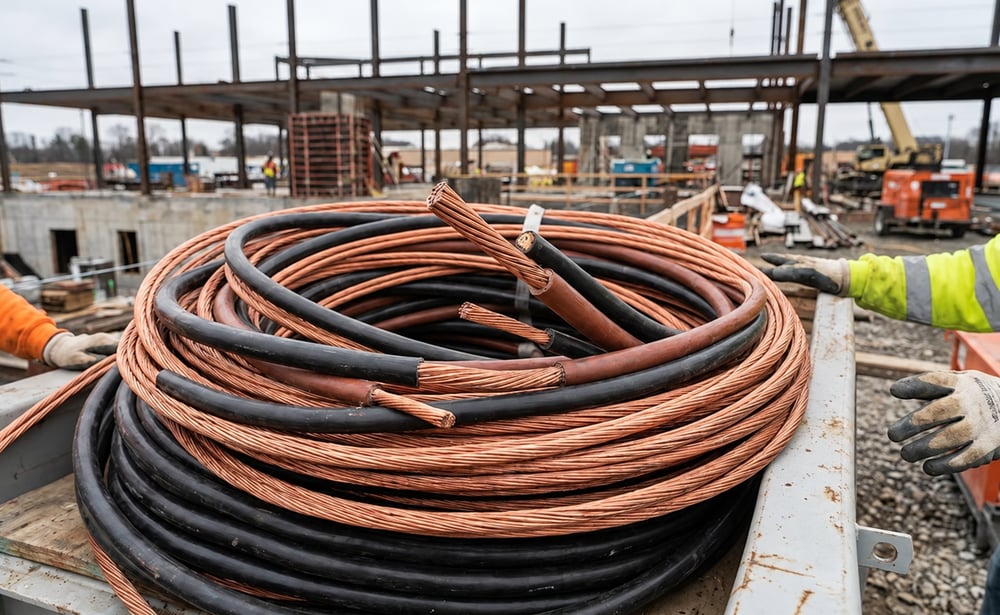
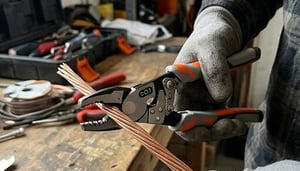
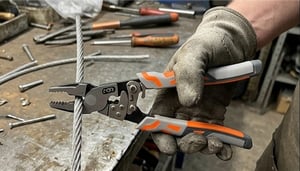
I watched him make a clean cut on a thick copper cable using what looked like a single, effortless squeeze.
No snap-back. No shaking his wrist after. Clean cut. Wire held perfectly in place.
“What the hell are those?” I asked.
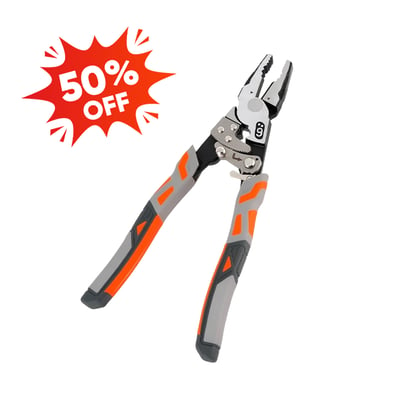
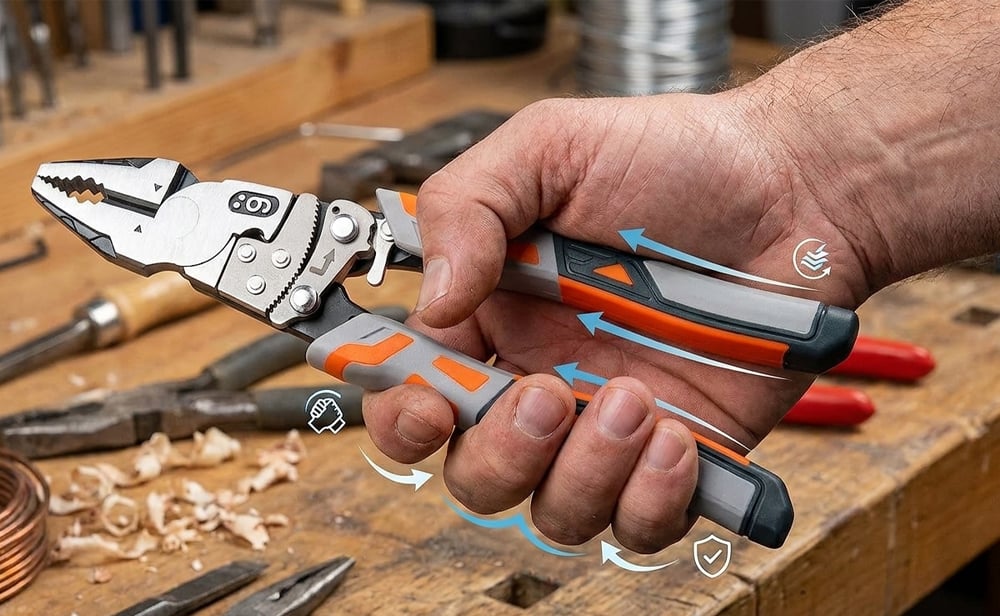
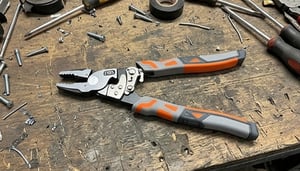
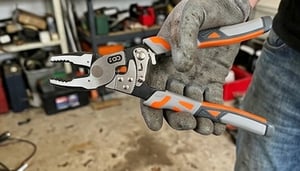
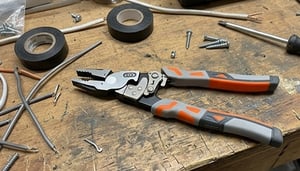
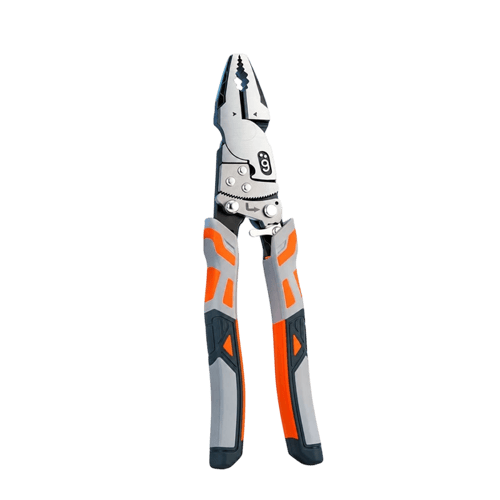
He held them up: 9-Inch Ratcheting Self-Locking Multifunction Pliers.
“It’s got a ratchet built into the pivot,” he said. “It locks the jaw in place so you don’t have to squeeze all at once. And it doesn’t snap back.”
I didn’t say anything for a second.
Because in 23 years of working in this trade, nobody had ever explained to me why my standard pliers were making my hands bleed every single day.
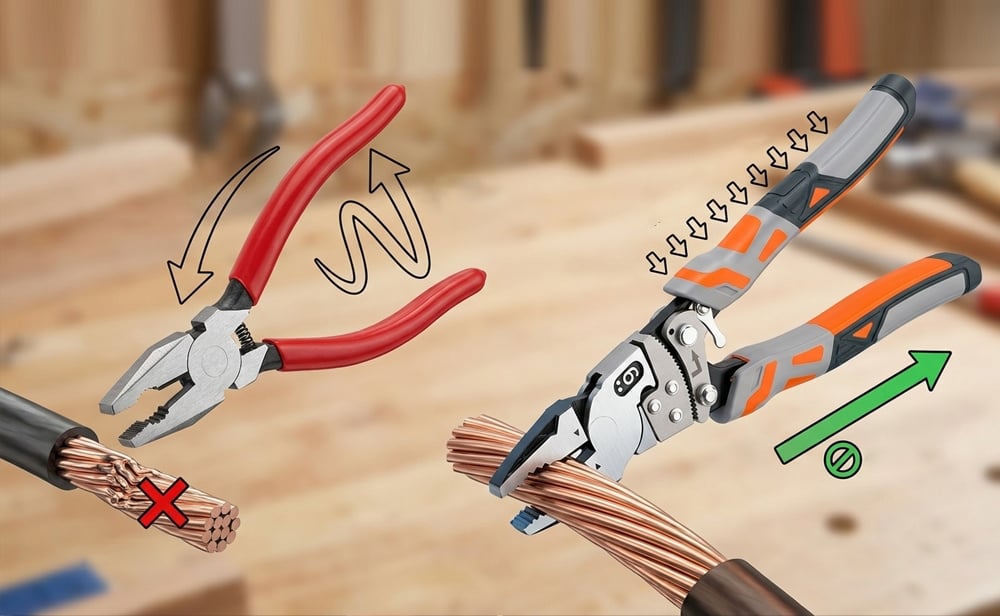
The Real Reason Your Hands Are Destroyed Isn’t Your Age. It’s Your Tool.
Marcus said something that stopped me cold:
“Those old pliers haven’t changed in a hundred years, Dave. They’re not broken. They’re just designed to work against your body.”
He was right. And once I understood the problem, everything made sense.
Here’s what’s actually happening every time you squeeze a standard pair of pliers on heavy steel:
Standard pliers operate on what engineers call Single-Stroke Dependency. That means 100% of the force required to snap a steel cable must be generated by your hand — all at once — in one continuous, maximum-effort squeeze.
If the wire is thick, your grip maxes out before the jaws cut through. The tool enters what Marcus called the “Kinetic Dead Zone” — where the blades pinch the wire instead of slicing it. So you push harder. And harder. And harder.
Until — SNAP.
The wire finally gives.
And all that explosive, stored-up tension has nowhere to go except back into your tendons.
That snap-back isn’t just painful. It’s a mechanical stress injury happening in real time, repeated hundreds of times per job.
The blades weren’t the problem. The force system was the problem.
And the sharper blades you’ve been buying? They weren’t fixing anything. They were a band-aid on a fundamentally broken mechanism.
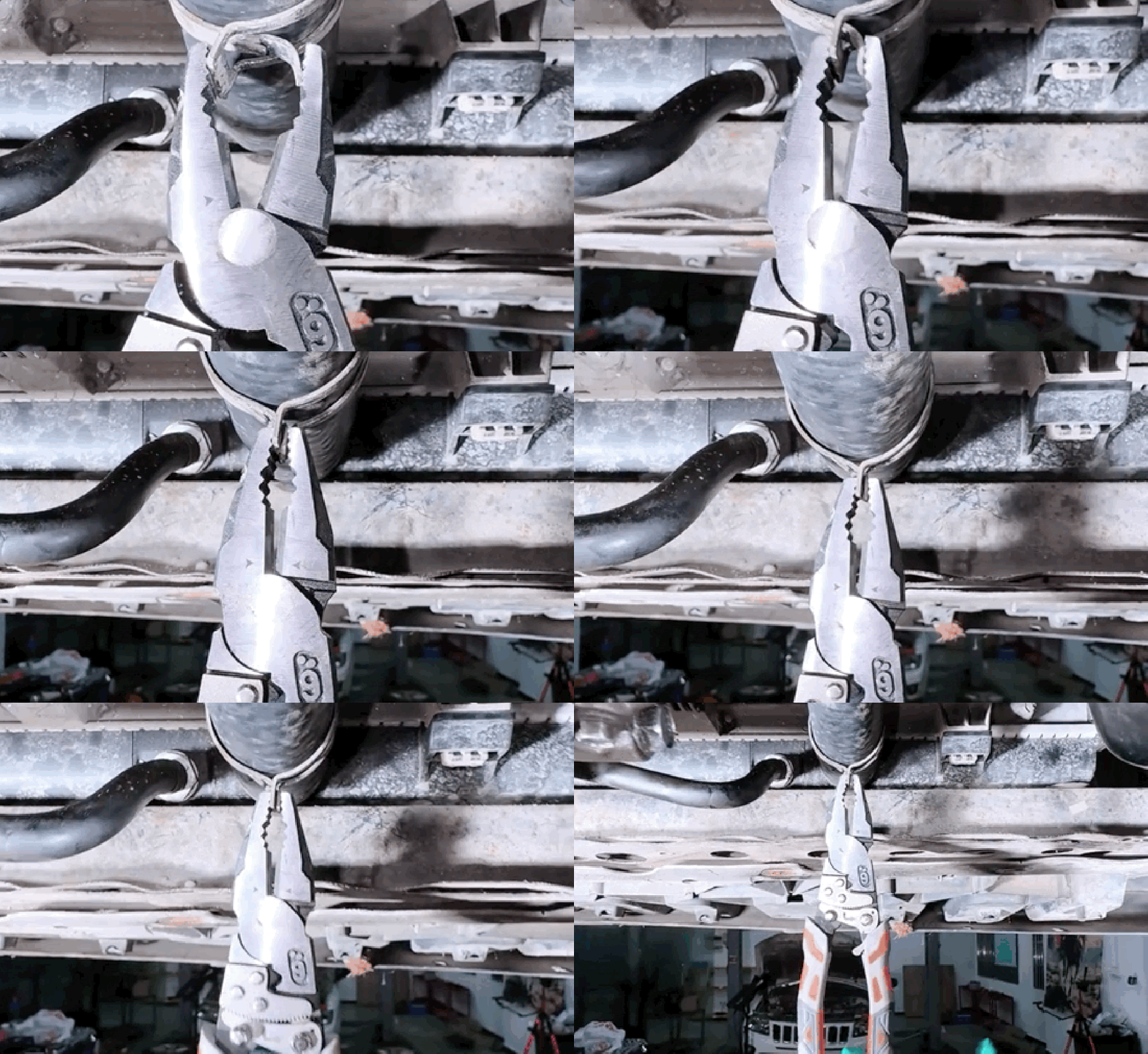
Built a Different Engine Inside These Pliers — And It Changes Everything
It didn’t just sharpen the jaws.
They replaced the entire mechanical system of the cut.
Built directly into the pivot point of these 9-inch pliers is an industrial-grade ratcheting gear mechanism — what I’ve started calling the Step-Lock Kinetic Engine™.
Here’s the simplest way I can explain how it works:
Think about a car jack.
You wouldn’t try to lift a two-ton vehicle in one massive shove. You pump the ratchet — small, easy strokes — and the jack accumulates the force step-by-step until the car rises effortlessly.
It works the same way on steel wire.
Instead of demanding one brutal, white-knuckle squeeze, the Step-Lock Kinetic Engine™ lets you make short, easy micro-squeezes. Each squeeze accumulates and locks the biting force. The jaw moves forward and stays there — it doesn’t spring back.
By the third or fourth easy squeeze, the jaws have built up enough stored mechanical force to shear cleanly through heavy-gauge steel or copper cable.
Your hand did almost nothing.
The ratchet did 90% of the lifting.
And because there’s no stored tension snapping backward when the wire breaks — there’s no rebound shock. No jarring. No knuckle-busting. Nothing.
Just a clean cut, and a jaw that holds the wire exactly where you left it.
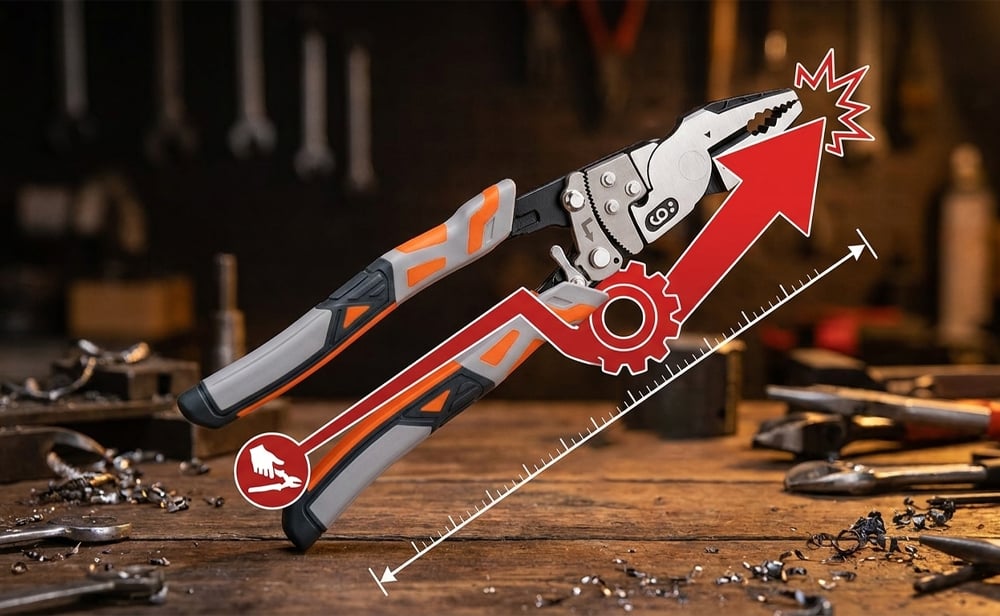
The 9-Inch “Golden Leverage Ratio” — Engineered, Not Guessed
The 9 inches aren’t arbitrary.
It engineered this specific length — 230 mm — to hit the optimal ratio between grip distance and jaw force amplification.
The physics are simple: the longer the handle relative to the jaw length, the less force your hand needs to generate crushing power at the tip.
A shorter plier forces you to make up the difference with raw muscle. A longer plier does the math for you.
Combined with the ratcheting mechanism, the result is a tool that can cut materials that would have sent a standard plier — and its user — into serious pain.
And Then There’s the Part I Didn’t Expect: I Threw Out Four Tools
I’ll be honest — the pain relief was what I came for.
But the tool pouch thing caught me completely off guard.
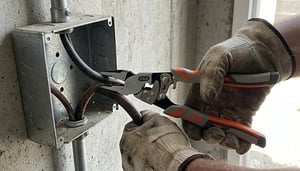
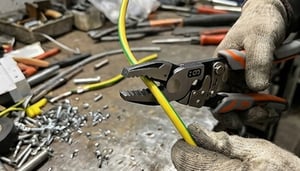
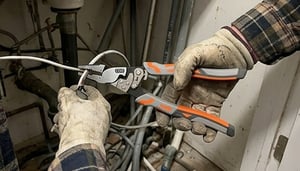
It cuts wire. Strips wire. Grips wire. Bends wire.
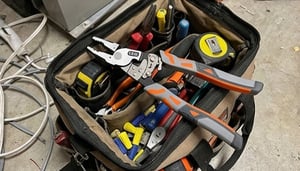
I’m not exaggerating when I say I pulled four tools off my belt the week after I started using these.
The integrated precision-ground jaw profiles handle copper, aluminum, and steel across every gauge I work with. The cuts are clean — no fraying, no second pass. And stripping insulation without nicking the conductor is something I used to need a dedicated stripper for.
Now I don’t.
My belt is lighter. My bag is cleaner. And I spend zero time fumbling between tools up on a ladder.
The Handle That Actually Fits a Human Hand
The two-tone, contoured handle isn’t just cosmetic.
The ergonomic shaping distributes grip load across your entire palm instead of concentrating pressure on your knuckles and thumb joint — which is exactly where arthritis and carpal tunnel flare up the most.
The textured grip surface holds firm even when your hands are sweaty from working a summer panel job in a closed mechanical room.
And because the self-locking ratchet holds the cut for you, you’re not white-knuckling the handle for sustained periods. You squeeze, the ratchet locks, you rest. Squeeze again, ratchet locks again.
Your hand fatigue on a long job drops dramatically.
“I’ve tried a lot of multi-tools over the years that claimed to do everything and did nothing well. These actually cut, strip, and grip — clean every time. And I don’t know how to explain it except to say my hands aren’t tired at the end of the day anymore. I’ve started keeping a second pair in my truck.”
— Marcus T., Electrician, Age 31
“I’ve got two bad knuckles from years of standard pliers snapping back on me. My doctor actually told me to ‘think about a different line of work.’ I started using about three months ago. I finish 10-hour jobs and I’m not icing my hand at night anymore. I don’t care how it works. It just works.”
— Ray S., HVAC Technician, Age 58
“I’m not a professional but I rewired most of my basement myself. Every video I watched online made cutting steel wire look terrifying. These pliers made it so manageable — I didn’t feel like I was going to slip and hurt myself. The jaw locks on and stays. That’s the part I kept coming back to. It just stays.”
— Sandra M., DIY Homeowner, Age 47
Say goodbye to repeated squeezing, slipping workpieces, and hand fatigue during tough cutting jobs.
Upgrade to the 9-Inch Ratcheting Self-Locking Multifunction Pliers — combining ratcheting force, automatic locking, and multiple functions to make cutting, stripping, gripping, and bending easier and more controlled.
Ours

| ✅ Ratcheting self-locking mechanism |
| ✅ 9-inch leverage for less effort |
| ✅ Cut, strip, grip & bend |
| ✅ Anti-slip ergonomic handle |
| ✅ Built for electrical, repair & DIY work |
Competitors
| ❌ No ratcheting or self-locking support |
| ❌ Requires more hand force |
| ❌ Limited single-purpose functions |
| ❌ Basic grip with less comfort |
| ❌ Less versatile for multiple tasks |
It's Not Just Me...
Countless Satisfied Users Say—The 9-Inch Ratcheting Self-Locking Multifunction Pliers Made Tough Cutting Jobs Easier!

“Much Easier on My Hands”
I do a lot of wiring and repetitive cutting, and regular pliers can wear my hands out quickly. The ratcheting action makes tougher cuts feel much more
manageable.


Verified Purchase



We Offers a 100%
Satisfaction Guarantee...
Try the 9-Inch Ratcheting Self-Locking Multifunction Pliers completely risk-free.
If it doesn’t help you cut, grip, and handle everyday repair tasks more easily, improve convenience, or provide reliable peace of mind, we’ll refund every penny — no questions asked.
With its ratcheting self-locking mechanism, 9-inch leverage, multifunction jaws, and anti-slip ergonomic handle, these pliers make electrical work, maintenance, machine repair, and DIY projects simpler and more convenient.
Handle repetitive cutting and gripping tasks with less effort and better control.
The Transformation I Didn’t Think Was Possible at This Stage of My Career
I’ve been using my pliers for four months now.
I still wake up and flex my hand in the morning. Old habit.
But I don’t wince anymore.
The deep, grinding ache that used to be the first sound of every workday has quieted down. Not gone entirely — I’ve got 23 years of wear in these joints. But quiet enough that mornings feel like mornings again.
I finished a full commercial panel rewire last week. Eight hours. Third floor. Tight spaces. Heavy steel cable.
When I got back to my truck, I sat there for a second and realized: I hadn’t shaken out my hand once. Not once.
That hasn’t happened on a job like that in two years.
I’m not ready to leave this trade. And now, I actually believe I don’t have to.

90-Day Money Back Guarantee

Guaranteed Safe and Secure Checkout

Fast Shipping

No-Hassle Returns
Frequently Asked Questions
Q: How does the ratcheting mechanism help?
A: The built-in ratchet accumulates cutting force with each squeeze, reducing the repeated open-and-close motion required with traditional pliers.
Q: What does the self-locking function do?
A: It automatically holds the jaw position while you work, helping reduce rebound and workpiece movement during cutting.
Q: What can these pliers be used for?
A: They combine wire cutting, stripping, gripping, and bending in one tool and can handle compatible copper, aluminum, and steel wire.
Q: Why is the tool 9 inches long?
A: The 9-inch / 230 mm design provides additional leverage, helping increase cutting force while reducing the amount of hand pressure required.
Q: What kind of work are they suitable for?
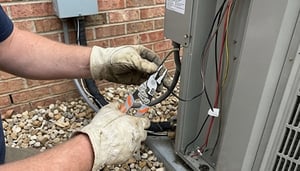
A: They are designed for electrical wiring, cable cutting, industrial maintenance, machine repair, and everyday DIY projects.